Marketplace Build: Engineering Guide for 2026
Building a marketplace platform represents one of the most complex yet rewarding engineering challenges in modern product development. Unlike traditional e-commerce or SaaS applications, a marketplace build requires orchestrating multiple user types, payment flows, trust mechanisms, and operational workflows simultaneously. Whether you're creating a service marketplace, product exchange, or specialized B2B platform, understanding the fundamental architecture and strategic decisions determines whether your platform scales successfully or crumbles under growth pressure.
Understanding Marketplace Architecture Fundamentals
A successful marketplace build starts with solid architectural foundations that support dual-sided interactions. The core challenge involves creating a system where supply meets demand efficiently while maintaining trust, security, and performance.
Core Components of Marketplace Infrastructure
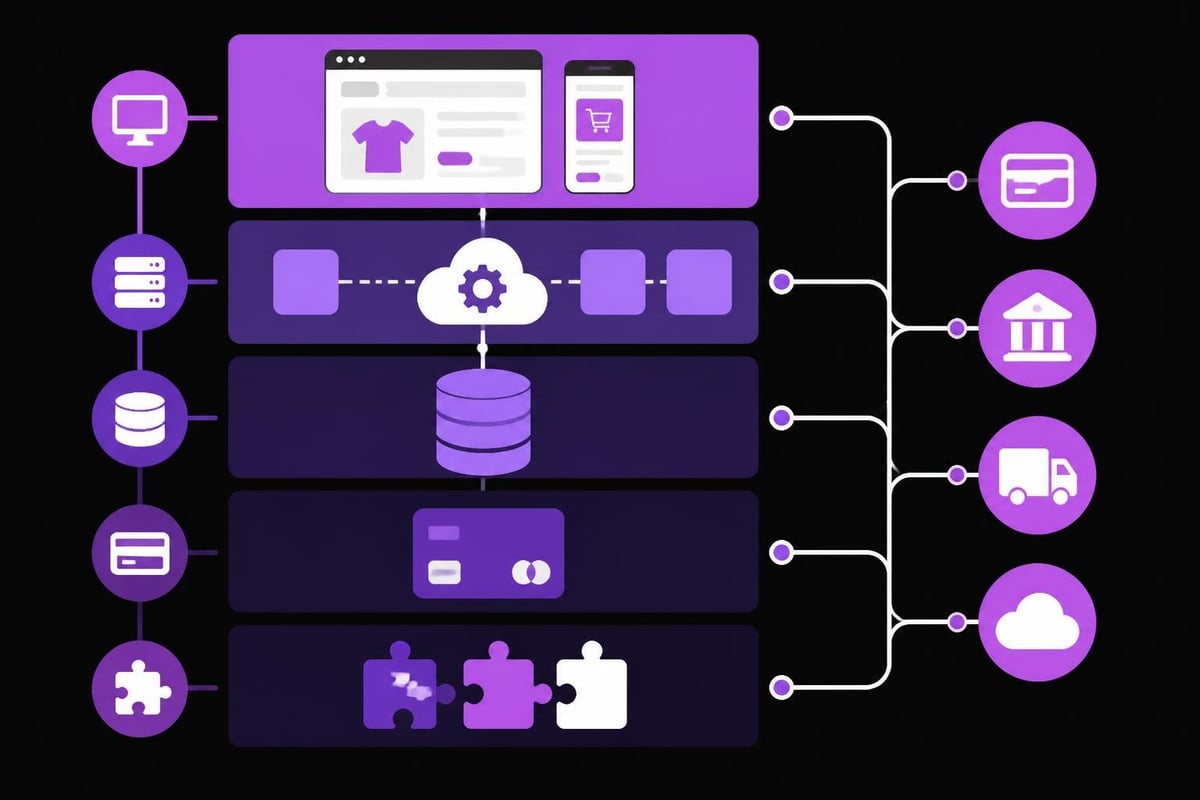
Every marketplace platform consists of several interconnected layers that work together seamlessly. The marketplace app architecture includes frontend interfaces, backend APIs, data persistence, infrastructure management, and third-party integrations.
Essential marketplace components include:
- User management systems for buyers and sellers
- Product or service listing engines with rich metadata
- Search and discovery mechanisms with filtering capabilities
- Transaction processing and payment orchestration
- Rating and review systems for trust building
- Messaging infrastructure for user communication
- Order management and fulfillment tracking
The two-sided marketplace architecture demonstrates how these components interact to create a cohesive platform. Your data model must accommodate different user roles, each with unique permissions, workflows, and interface requirements.
Database Design for Marketplace Scalability
Database architecture represents a critical decision point in any marketplace build. Your schema must support complex relationships between users, listings, transactions, reviews, and messages while maintaining query performance as data volume grows.
Consider implementing these database patterns:
- Polymorphic associations for items that can belong to multiple entity types
- Soft deletes to preserve transaction history and maintain data integrity
- Audit trails for tracking changes to critical records like listings and payments
- Denormalization for frequently accessed data to improve read performance
- Sharding strategies for horizontal scaling as user base expands
When approaching web development for marketplaces, database indexing becomes crucial. Creating indexes on frequently queried fields like category, location, price range, and seller ID dramatically improves search performance.
Payment Processing and Financial Architecture
Payment infrastructure forms the backbone of any marketplace build. Unlike single-vendor platforms, marketplaces must handle split payments, escrow mechanisms, refunds, and complex fee structures while maintaining compliance with financial regulations.
Implementing Multi-Party Payment Flows
Your marketplace needs to route funds between buyers, sellers, and the platform itself. This requires careful integration with payment service providers that support marketplace-specific features.
| Payment Feature | Business Benefit | Technical Complexity |
|---|---|---|
| Split payments | Automatic commission deduction | Medium |
| Escrow holding | Buyer protection, dispute resolution | High |
| Delayed transfers | Verify delivery before payout | Medium |
| Multi-currency | Global marketplace reach | High |
| Recurring billing | Subscription-based models | Medium |
Building payment rails requires understanding regulatory requirements across different jurisdictions. Payment Card Industry Data Security Standard (PCI DSS) compliance alone involves extensive security measures that influence architectural decisions.
Critical payment considerations:
- Never store raw credit card data on your servers
- Implement tokenization for recurring payments
- Build comprehensive transaction logging for auditing
- Create automated reconciliation processes
- Design for payment failure scenarios and retry logic
The financial infrastructure must support various business models including commission-based, subscription, listing fees, or hybrid approaches. Your marketplace build should accommodate future monetization experiments without requiring architectural overhauls.
Trust and Safety Systems
Trust mechanisms differentiate successful marketplaces from failed experiments. Without robust verification, ratings, and dispute resolution systems, neither buyers nor sellers will engage confidently with your platform.
Building Verification Infrastructure
Identity verification prevents fraud and creates accountability within your marketplace ecosystem. The verification depth required depends on transaction values and regulatory requirements in your vertical.
Implement tiered verification levels:
- Email verification as baseline identity confirmation
- Phone number verification for additional security layer
- Government ID verification for high-value transactions
- Business documentation for commercial sellers
- Bank account verification to confirm payout capability
Your marketplace build should integrate with third-party KYC (Know Your Customer) providers to automate verification workflows. These AI automation tools can verify documents, check against watchlists, and assess risk scores without manual review.

Designing Effective Rating Systems
Reviews and ratings provide social proof that drives conversion and repeat transactions. However, poorly designed rating systems create perverse incentives and fail to surface quality signals.
Rating system best practices:
- Require verified purchases before allowing reviews
- Implement two-way ratings where both parties evaluate each other
- Create weighted algorithms that prioritize recent feedback
- Allow detailed criteria ratings beyond simple star counts
- Enable response mechanisms for sellers to address concerns
- Build moderation workflows to prevent fake or abusive reviews
According to marketplace best practices, focusing intensely on user experience and trust mechanisms early creates defensible competitive advantages that pure feature development cannot replicate.
Search and Discovery Optimization
A marketplace build lives or dies by its search functionality. Users must find relevant listings quickly, or they abandon the platform. This requires sophisticated search architecture that balances relevance, performance, and personalization.
Implementing Robust Search Infrastructure
Basic database queries fail at marketplace scale. Implementing dedicated search engines like Elasticsearch or Algolia provides the speed and relevance modern users expect.
Your search implementation needs:
- Full-text search across titles, descriptions, and attributes
- Faceted filtering by category, price, location, ratings, and custom fields
- Geospatial queries for location-based marketplaces
- Autocomplete suggestions to guide user intent
- Synonym handling to match varied terminology
- Ranking algorithms that surface quality listings
- Personalization based on user history and preferences
Building effective product design for search interfaces requires extensive user testing. The balance between power-user filtering capabilities and simple, intuitive discovery represents an ongoing design challenge.
Scaling Your Marketplace Platform
The guide to building a scalable marketplace emphasizes that scalability decisions made during initial marketplace build determine your platform's ability to handle growth without complete rebuilds.
Technical Scalability Strategies
As your marketplace grows, different components face different scaling challenges. User-generated content creates storage demands, search indices grow massive, and transaction processing requires higher throughput.
| Scaling Challenge | Solution Approach | Implementation Timeline |
|---|---|---|
| Database reads | Read replicas, caching layers | Months 3-6 |
| Image storage | CDN integration, object storage | Months 1-3 |
| Search performance | Dedicated search cluster | Months 6-12 |
| API throughput | Load balancing, microservices | Months 12-18 |
| Geographic latency | Multi-region deployment | Months 18-24 |
Implement caching strategies at multiple levels. Redis or Memcached can cache database queries, API responses, and computed values. CDNs cache static assets and can even cache dynamic content with appropriate headers.
Microservices architecture allows independent scaling of different marketplace functions. Your listing service might need different resources than your messaging service. However, microservices add operational complexity that smaller teams should avoid until scaling demands justify the overhead.
Operational Scaling Considerations
Technical infrastructure represents only half the scaling equation. Your marketplace build must support operational workflows that scale alongside user growth.
Operational systems to implement:
- Automated fraud detection with manual review queues
- Tiered customer support with escalation paths
- Seller onboarding automation with verification checkpoints
- Content moderation tools with AI-assisted flagging
- Dispute resolution workflows with clear SLA tracking
- Analytics dashboards for monitoring marketplace health
The multi-vendor marketplace development guide highlights how operational challenges often create more constraint than technical limitations. Building internal tools that empower your operations team becomes critical as transaction volume increases.
Mobile-First Marketplace Development
In 2026, mobile traffic dominates most consumer marketplaces. Your marketplace build must deliver excellent mobile experiences or risk losing the majority of potential users.
Progressive Web Apps vs Native Applications
The decision between progressive web apps (PWAs) and native mobile applications impacts development timelines, maintenance overhead, and user experience quality.
PWAs offer faster development and single codebase maintenance. They work across devices without app store approval processes. However, native apps provide superior performance, offline capabilities, and access to device features like push notifications and camera integration.
For most marketplace builds, starting with responsive web design and PWA capabilities, then developing native apps once product-market fit is validated, represents the optimal path. This approach, detailed in our guide on building mobile apps, balances speed to market with long-term platform quality.

Mobile optimization priorities:
- Touch-optimized interfaces with appropriate tap target sizes
- Image optimization for fast loading on cellular networks
- Simplified checkout flows that minimize form fields
- Mobile payment integration (Apple Pay, Google Pay)
- Location services for local marketplace discovery
- Camera integration for easy listing photo uploads
When building web apps with marketplace functionality, performance budgets become essential. Set maximum page load times and continuously monitor real user metrics to ensure mobile experience remains competitive.
Launching Your Minimum Viable Marketplace
The insights from marketplace rebuilds consistently emphasize starting focused rather than building comprehensive platforms. Your initial marketplace build should validate core assumptions with minimal feature complexity.
Defining Your MVP Scope
Feature scope determination separates successful marketplace launches from projects that never ship. Identify the absolute minimum functionality required to facilitate a transaction between buyer and seller.
Core MVP features typically include:
- Basic user registration and authentication
- Simple listing creation with photos and descriptions
- Search and browse by category
- Direct messaging between users
- Basic payment processing
- Simple rating system post-transaction
Deliberately exclude features like advanced filters, recommendation engines, sophisticated analytics, mobile apps, and complex verification initially. These additions come after validating that users actually want to transact on your platform.
The marketplace development roadmap recommends dedicating significant time to discovery and solution design before writing code. Understanding your target users' workflows, pain points, and expectations shapes technical decisions throughout the marketplace build.
Choosing Your Technology Stack
Technology choices during initial marketplace build create lasting consequences. While modern frameworks offer rapid development, selecting tools that support long-term scalability prevents costly rewrites.
Recommended technology considerations:
- Choose established frameworks with strong marketplace plugins (Ruby on Rails, Django, Laravel)
- Select databases that handle complex queries efficiently (PostgreSQL over MySQL)
- Use cloud platforms that simplify scaling (AWS, Google Cloud, Azure)
- Implement API-first architecture for future mobile app integration
- Adopt version control and CI/CD practices from day one
Building SaaS MVPs shares many technical similarities with marketplace builds, particularly around user management, subscription handling, and multi-tenancy patterns. However, marketplaces add complexity through dual user types and transaction intermediation.
Marketplace Monetization Models
Your business model influences technical architecture throughout the marketplace build process. Different monetization approaches require different features, integrations, and operational capabilities.
Revenue Model Options
| Model | Description | Technical Requirements | Best For |
|---|---|---|---|
| Commission | Percentage of transaction value | Split payment processing, transaction tracking | High-volume, varying prices |
| Listing fees | Charge to post items | Payment at listing creation, expiration management | Lower-volume, standard pricing |
| Subscription | Recurring access fees | Subscription billing, tier management | Professional sellers, B2B |
| Freemium | Basic free, premium features paid | Feature gating, upgrade workflows | Growing seller base |
| Lead fees | Charge for connecting parties | Lead tracking, quality scoring | Service marketplaces, quotes |
Many successful marketplaces combine models. You might charge listing fees plus commission, or offer free basic listings with paid premium placement. Your marketplace build should support multiple revenue streams to enable business model experimentation.
Commission-based models align platform success with user success, creating virtuous growth cycles. However, they require robust transaction tracking and split payment infrastructure. Implementing these systems correctly from the start prevents painful migrations later.
Regulatory Compliance and Legal Framework
Marketplace platforms face complex regulatory requirements that vary by geography, vertical, and transaction type. Your marketplace build must incorporate compliance requirements early, as retrofitting compliance systems proves expensive and risky.
Essential Compliance Considerations
Depending on your marketplace category, you may need to comply with financial regulations, data privacy laws, consumer protection statutes, and industry-specific requirements.
Key compliance areas:
- Payment processing regulations (PCI DSS, anti-money laundering)
- Data privacy laws (GDPR, CCPA, local equivalents)
- Consumer protection requirements (right to refund, dispute resolution)
- Tax collection and remittance obligations
- Industry-specific licensing (real estate, healthcare, finance)
- Employment law if facilitating gig work
The compliance by design approach integrates regulatory requirements into product architecture rather than treating them as constraints to work around. This philosophy prevents compliance failures that can shut down marketplaces entirely.
Building marketplaces in regulated industries like finance requires specialized expertise in both technical implementation and regulatory frameworks. Understanding these constraints shapes everything from user verification workflows to transaction monitoring systems.
Analytics and Data Infrastructure
Data drives marketplace optimization. Your marketplace build needs comprehensive analytics infrastructure from launch to understand user behavior, transaction patterns, and platform health metrics.
Implementing Marketplace Metrics
Generic web analytics fail to capture marketplace-specific dynamics. You need custom tracking for supply-side metrics, demand-side metrics, and cross-side interactions.
Critical marketplace metrics:
- Gross Merchandise Volume (GMV) and growth trends
- Take rate (commission percentage) and revenue
- Active buyer and seller counts
- Liquidity ratio (searches resulting in transactions)
- Time to first transaction for new users
- Repeat transaction rates
- Customer acquisition cost by channel
- Lifetime value by user cohort
Building dashboards that surface these metrics to stakeholders requires thoughtful data modeling and visualization. Different users need different views: executives want high-level trends, operations teams need transaction-level detail, and sellers want performance analytics for their listings.
Implement event tracking throughout user journeys. Tools like Segment, Mixpanel, or Amplitude capture behavioral data that reveals drop-off points, successful conversion paths, and feature usage patterns. This data informs continuous marketplace optimization.
Building for Network Effects
The marketplace strategy principles emphasize that marketplace success depends on reaching liquidity where supply and demand create self-reinforcing growth. Your marketplace build should accelerate path to liquidity.
Cold Start Problem Solutions
Every marketplace faces the chicken-and-egg problem: buyers won't come without selection, sellers won't list without buyers. Technical solutions alone cannot solve this, but your platform can enable strategic solutions.
Tactical approaches to bootstrap liquidity:
- Manually recruit initial supply before opening to buyers
- Subsidize one side temporarily to build critical mass
- Start hyperlocal to concentrate limited users geographically
- Create value for sellers alone before requiring transactions
- Build single-player mode that provides utility without network
Your marketplace build should support these strategies through flexible onboarding flows, subsidized pricing capabilities, and geographic targeting features. Technical flexibility enables business strategy experimentation.
Building a successful marketplace requires balancing complex technical architecture, strategic business decisions, and operational excellence. From payment infrastructure and trust systems to search optimization and mobile experiences, every component must work together to create a platform that serves both buyers and sellers effectively. If you're ready to bring your marketplace vision to life with expert engineering and product development, Absolute Foundry provides end-to-end marketplace build services, handling the technical complexity while you focus on growing your user base and expanding your market.